Enterprise Server Virtualization & Cluster Consolidation
Patel Galaxify Solutions sizes, supplies, stages, and deploys high-availability enterprise virtualization clusters. Maximize hardware compute density, streamline hypervisor licensing, and achieve zero-downtime workload mobility with VMware vSphere/VCF, Microsoft Hyper-V, and Proxmox VE ecosystems.
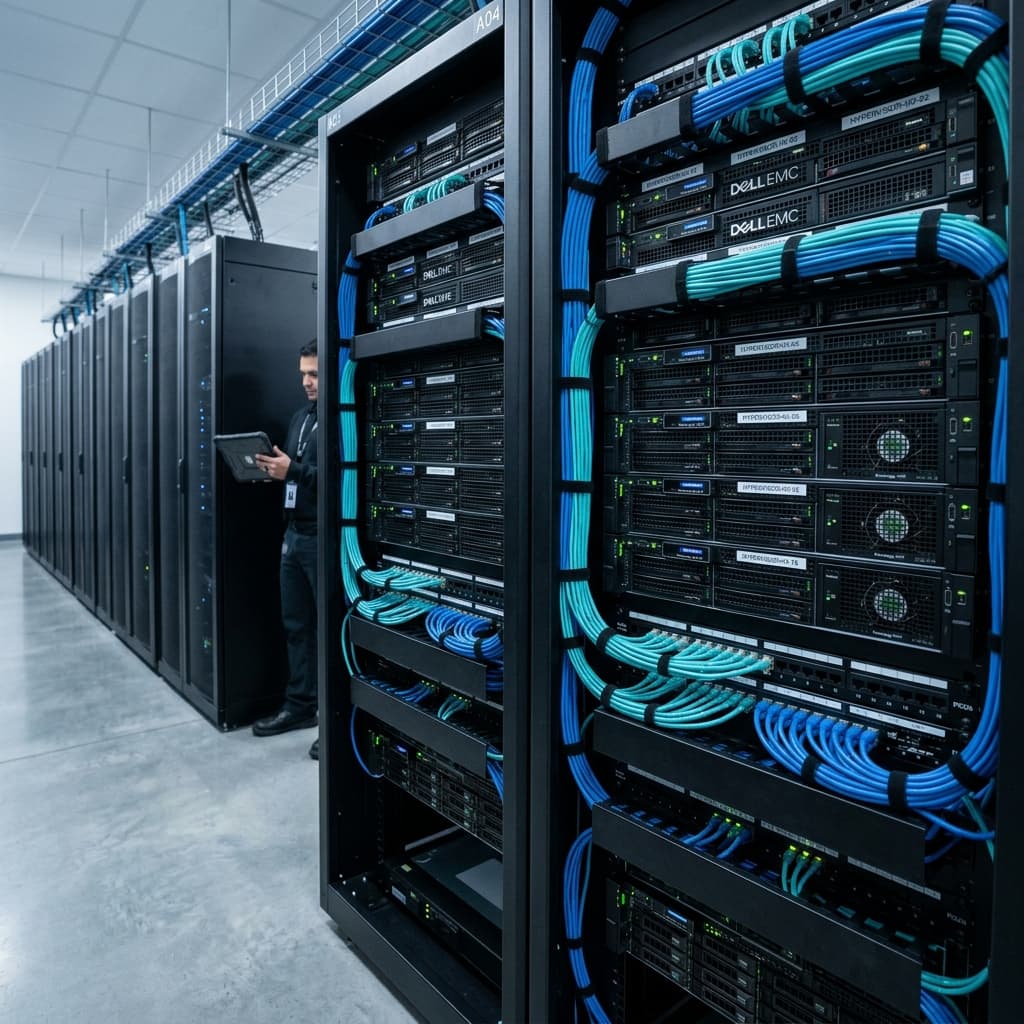
MULTI-NODE HYPERVISOR CLUSTER
Dual-socket x86 server nodes with redundant 25GbE backplane
Why Enterprise Virtualization Remains Fundamental to IT Strategy
Modern virtualization transforms rigid bare-metal hardware into elastic pools of computing, storage, and networking that adapt dynamically to enterprise application demands.
Server Consolidation & Footprint Reduction
Collapse dozens of underutilized standalone physical servers (typically averaging 10%–15% CPU utilization) onto dense, dual-socket x86 server clusters running at balanced 65%–75% efficiency, dramatically reducing rack space and power draw.
Dynamic Resource Balancing & Agility
Allocate compute, memory, and vGPU power on demand without waiting weeks for hardware acquisition. Distributed Resource Schedulers (DRS) dynamically rebalance virtual machine workloads across hosts to eliminate performance hotspots.
High Availability & Fault Tolerance
Eliminate single points of failure. In the event of a sudden physical motherboard, RAM, or power supply failure, the clustering layer automatically detects host loss and restarts affected virtual machines on surviving nodes within seconds.
Zero-Downtime Maintenance & Live Migration
Perform rolling firmware updates, hardware maintenance, and hypervisor patches during regular business hours. Live migration technologies (vMotion, Storage vMotion, Live Migration) transfer active running VMs without user disconnection.
Evaluating Enterprise Virtualization Platforms
We provide objective architectural guidance and supply HCL-certified server hardware tailored to your chosen hypervisor stack.
VMware vSphere & VMware Cloud Foundation (VCF)
The premier enterprise hypervisor architecture featuring the bare-metal ESXi kernel, centralized vCenter Server orchestration, vSphere Distributed Switch (vDS), vSphere HA, and Distributed Resource Scheduler (DRS).
IDEAL WORKLOAD FIT:
Mission-critical enterprise virtualization, core database clusters (SAP HANA, Oracle), extensive VDI deployments, and hybrid cloud integration.
KEY ARCHITECTURAL ADVANTAGES:
- Industry-leading hypervisor maturity, telemetry, and universal third-party ISV backup/security integration
- Sophisticated resource management (vSphere DRS, proactive HA, Predictive DRS, memory ballooning/compression)
- Native support for advanced GPU partitioning (vGPU) and high-density virtualization fabrics
OPERATIONAL CONSIDERATIONS:
- Transitioned to per-core subscription licensing bundles (VCF and VMware vSphere Foundation - VVF) requiring accurate core planning
- Requires active subscription maintenance for software updates and technical OEM escalation
RECOMMENDED SERVER PLATFORMS:
Dell PowerEdge R760 / R660, HPE ProLiant DL380 / DL360 Gen11, Lenovo ThinkSystem SR650 V3
Microsoft Hyper-V & Windows Server
A mature, high-performance Type-1 hypervisor built directly into Windows Server. Offers seamless integration with Windows Failover Clustering, Hyper-V Replica, and Microsoft System Center Virtual Machine Manager (SCVMM).
IDEAL WORKLOAD FIT:
Enterprises with extensive Microsoft software ecosystems (Active Directory, SQL Server, Exchange, .NET), branch office hypervisors, and Azure hybrid clouds.
KEY ARCHITECTURAL ADVANTAGES:
- Windows Server Datacenter edition grants unlimited virtual Windows Server guest instances on licensed host physical cores
- Native Hyper-V Replica provides built-in asynchronous VM replication for offsite disaster recovery without extra hypervisor licensing
- Direct integration with Microsoft Azure hybrid services (Azure Arc, Azure Stack HCI edge)
OPERATIONAL CONSIDERATIONS:
- Third-party Linux guest performance requires synthetic integration service drivers for optimal storage and network I/O
- Advanced automated load-balancing requires System Center VMM or Azure Stack HCI orchestration
RECOMMENDED SERVER PLATFORMS:
Dell PowerEdge R760, HPE ProLiant DL380 Gen11, Cisco UCS C220 / C240 M7
Proxmox Virtual Environment (Proxmox VE)
A complete open-source enterprise virtualization platform combining Linux Kernel-based Virtual Machine (KVM) for full OS virtualization and Linux Containers (LXC) for lightweight, near-native execution of containerized workloads.
IDEAL WORKLOAD FIT:
Cost-conscious mid-market IT, software development laboratories, academic institutions, telecom labs, and open-source infrastructure teams.
KEY ARCHITECTURAL ADVANTAGES:
- Zero per-socket or per-core software license acquisition fees (open-source AGPLv3 licensing)
- Integrated out-of-the-box support for Ceph software-defined storage, OpenZFS, and web GUI cluster administration
- Seamless integration with Proxmox Backup Server (PBS) featuring client-side encryption and deduplication
OPERATIONAL CONSIDERATIONS:
- Commercial production environments strongly warrant purchasing Proxmox enterprise repository subscription tiers for vendor SLA support
- Fewer third-party commercial enterprise backup integrations compared to vSphere; requires in-house Linux systems engineering proficiency
RECOMMENDED SERVER PLATFORMS:
Supermicro SuperServer Systems, Dell PowerEdge 16G, HPE ProLiant Gen11 Custom Build-to-Order
Nutanix AHV (Acropolis Hypervisor)
An enterprise-grade, hardened Type-1 hypervisor built on open-source KVM and delivered natively within the Nutanix Cloud Platform. Eliminates hypervisor silos by consolidating compute and storage into a single unified management pane.
IDEAL WORKLOAD FIT:
Turnkey hyperconverged deployments, distributed enterprise clouds, and organizations looking to eliminate separate hypervisor licensing overhead.
KEY ARCHITECTURAL ADVANTAGES:
- Natively included with Nutanix software licensing without separate hypervisor license fees or per-core hypervisor surcharges
- Centrally managed via Nutanix Prism Central with one-click hypervisor updates and automated VM placement
- Integrated software-defined networking, security micro-segmentation (Flow), and native snapshot protection
OPERATIONAL CONSIDERATIONS:
- Requires deployment on certified Nutanix ReadyNode platforms or Nutanix appliances
- Architected specifically for hyperconverged distributed storage environments rather than traditional external Fibre Channel SANs
RECOMMENDED SERVER PLATFORMS:
Dell PowerEdge XC Series, HPE ProLiant DX Systems, Lenovo ThinkAgile HX Series
End-to-End Infrastructure Integration Architecture
Virtualization does not exist in isolation. High cluster stability requires synchronized alignment across physical compute, shared storage fabrics, lossless networking, and backup targets.
1. Compute & NUMA Sizing
Non-Uniform Memory Access Awareness
Properly sizing virtual machines requires aligning vCPU and RAM allocations within the physical boundaries of a single CPU socket (NUMA node). Crossing NUMA boundaries forces memory access over inter-socket interconnects (UPI/Infinity Fabric), introducing latency. We size physical hosts with high core counts (Intel Xeon Scalable 4th/5th Gen or AMD EPYC 9004) to keep enterprise VM workloads NUMA-local while enforcing safe 3:1 to 5:1 consolidation ratios.
2. Shared Storage Fabric Decoupling
FC SAN, iSCSI, NFS & Software-Defined Storage
Virtualization high availability depends on shared storage accessible by all hosts in the cluster. We integrate virtualization hosts with high-speed Fibre Channel (32G/64G), iSCSI, or NVMe-oF enterprise SAN arrays, or engineer distributed software-defined storage (VMware vSAN / Ceph). Decoupling VM compute from physical disks allows virtual machines to fail over instantaneously between physical chassis without storage re-mirroring.
3. Lossless Multi-VLAN Networking
Distributed Virtual Switches & NIC Teaming
A single virtualization host aggregates traffic for hundreds of virtual machines alongside high-volume cluster communication. We deploy dual 25GbE SFP28 redundant top-of-rack interfaces, leveraging Distributed Virtual Switches (vDS) and IEEE 802.1Q VLAN tagging to strictly isolate Management, VM Production, vMotion / Live Migration, and Storage (iSCSI/vSAN) traffic planes with automated link failover.
4. Agentless Backup & Snapshot Discipline
CBT / RCT APIs & Storage Immutability
Hypervisor snapshot technology provides temporary, crash-consistent restore points during software upgrades but must never be retained as permanent backups. We integrate modern enterprise backup engines (Veeam, Commvault) utilizing hypervisor Changed Block Tracking (CBT) and Resilient Change Tracking (RCT) APIs to perform non-disruptive, agentless incremental backups directly to hardened immutable storage repositories.
Structured Virtualization Sizing, Staging & Cutover
From capacity baseline auditing to physical pull-testing, our deployment methodology guarantees zero unexpected downtime and seamless production cutovers.
Workload Inventory & Performance Profiling
We audit your physical and virtual fleet: peak CPU consumption, committed memory working sets, disk read/write IOPS, network throughput, and storage growth trajectories.
Cluster Architecture & Sizing BOM
Our architects calculate the required physical host count, CPU core density, DDR5 ECC RAM allocations, and N+1 host redundancy headroom across your preferred hypervisor ecosystem.
Tier-1 Hardware Procurement & Licensing
Procuring 100% genuine server hardware (Dell, HPE, Lenovo) and vendor-aligned hypervisor software subscriptions through authorized national distribution channels with GST tax invoices.
Facility Staging, HCL Burn-In & Clustering
Unboxing, rack mounting, redundant cabling, out-of-band management setup (iDRAC/iLO), RAID/HBA configuration, hypervisor installation, and virtual cluster initialization in our staging center.
P2V & V2V Migration Execution
Assisting your engineering team with Physical-to-Virtual (P2V) and Virtual-to-Virtual (V2V) cross-hypervisor conversions, scheduling cutover windows, and validating application dependencies.
High Availability Stress Testing & AMC Handover
Executing physical pull-tests (unplugging redundant power feeds, simulating network failover, and validating automated VM restarts) backed by comprehensive 8×5 NBD or 24×7 4h AMC SLAs.
Enterprise Virtualization Planning & Procurement
Architectural answers to critical licensing, consolidation, migration, and maintenance questions.
How does the Broadcom acquisition of VMware affect enterprise licensing and sizing?
What is the recommended vCPU-to-pCPU consolidation ratio for enterprise workloads?
Can Patel Galaxify Solutions assist with migrating workloads from VMware to Proxmox VE or Microsoft Hyper-V?
Why is shared storage necessary to achieve true hypervisor High Availability (HA)?
What warranty coverage and Annual Maintenance Contracts (AMC) are available for virtualization clusters?
Complementary Enterprise Solutions
Virtualization clusters connect directly with our enterprise server hardware, high-IOPS storage arrays, and immutable backup systems.
Enterprise Servers & Compute
High-density dual-socket rack servers, high-core processors, and mission-critical virtualization hosts.
Hyperconverged Infrastructure (HCI)
Pre-validated vSAN and Nutanix ReadyNodes collapsing compute, storage, and virtualization into scalable building blocks.
Enterprise Storage Solutions
High-IOPS All-Flash NVMe arrays, Fibre Channel SANs, and high-throughput NAS targets for shared cluster storage.
Backup & Disaster Recovery
Hardened immutable backup repositories, continuous replication, and automated disaster recovery orchestration.
Design Your Resilient Virtualization Cluster
Connect with Patel Galaxify Solutions engineers to evaluate workload consolidation ratios, size physical host memory and processor cores, and source HCL-certified server hardware with Pan-India staging and warranty support.